Local residents responding to the NCS (National Citizen Survey) were generally positive about life in Charlottesville – except when it came to traffic and parking. From their tepid responses, NBC29 derived the headline, “Residents Fed Up With Charlottesville Parking,” an odd choice of words given that demand for both residential and commercial space in parking-challenged areas of the city is higher than it has ever been.
Complaints about parking are part of a larger problem of public ignorance about trade-offs. It’s a bit like the airline legroom conundrum, in which passengers consistently complain about decreasing legroom on planes, yet continue to vote for it with their wallet by purchasing cheaper tickets on planes that have packed more people in and declining to pay for small seat upgrades that provide more space at the cost of having fewer passengers to split the gas bill.
Here are the facts and I'll give them to you straight:
1. You cannot have a great urban place without a parking problem. Cars incredible amounts of space, which is inevitably ugly and degrading to the rest of the environment. You don’t take your mother-in-law sightseeing on the median of Route 29 when she comes to visit.
2. Space is the most precious commodity in a city. The whole point of a city is for a bunch of people to live near enough to each other that they can all benefit from each other's presence and have companies and stores and churches and art galleries and concerts and dance parties. The need to navigate our gargantuan metallic shells at high speeds and then leave them sitting unused for hours at a time is what made people tear down places like Vinegar Hill and Jackson Ward and get rid of public parks so that they could replace them with roads and parking lots (certainly racism played a big part in deciding which places would be torn down). If you want to drive your car at 60 miles an hour and park it free of charge, there are many excellent venues nearby. But Charlottesville residents – and residents of any other city – have opted instead to give up some of that ability in order to enjoy the quality of life that comes from being a part of a living community with a robust economy and an active public life in beautiful public spaces.
3. Having to look for parking is not a parking problem. Having to park two blocks away is not a parking problem. That's called life. In three years of going downtown multiple times a week, I have never had to look for parking for more than a few minutes.
4. Traffic and parking demand are signs of economic activity happening. Show me an urban area without a traffic problem and I will show you a place where you can't find a job.
5. Alleviating growing traffic and parking problems by prioritizing auto travel makes walking, transit, and biking less effective and attractive at exactly the time when they should be starting to take over from auto travel. Northern Virginia should be a cautionary tale. As demand and population increased, too many NoVA localities doubled down on more lanes and more parking spaces, continued to allow cul-de-sacs and disconnected roads, and didn't take steps to ensure places would be accessible to other modes of transportation. Now they are playing catch-up.
6. When parking is free or costs too little (as it does everywhere because we require it to be free), then there will be too much of it. Meanwhile it will always seem like there is not "enough" of it. Imagine if hamburgers were free. People would eat them all the time, no one would want to make them, and we would all complain about how there weren't enough to meet the insatiable demand for [free] hamburgers at all times. Eventually we would probably be producing twice as many hamburgers as could ever be eaten, just to ensure enough were always available when a rush of citizens felt the urge. It sounds absurd, but that’s exactly what we do with parking, building four to eight spaces for every car that could possibly need one. Every car in Albemarle County requires 1.5 basketball courts worth of pavement to drive and park in. Charlottesville City has a third of a basketball court worth of pavement for every car.
What Charlottesville actually needs is a system of parking meters for all public parking spaces in commercial and high-density residential districts. Parking space is finite and shouldn’t be free. The pricing needs to be variable, based on typical demand for parking on that particular street at that particular time. Cities across the country are moving this direction, using modern parking meters that allow you to pay by credit card and that send data to mobile apps that show where open spaces are located.
If we switched to this system, which the Downtown Business Association already supports, the benefits would be visible immediately:
1. Employees will park farther away since they are paying for more time and are only making one trip walking. People shopping will park closer since they need less time in the space and will be walking back and forth more. Stores can reimburse them for it if they think that's a good way to attract business.
2. People who live nearby will walk. About 30,000 people live within a mile of the downtown mall or the university, including myself. It’s only a 20-minute walk to the mall, but sometimes I get in my car and drive (and park) anyway because why not? Saving a couple bucks would be a great “why not.”
3. If parking in each area is priced correctly, it will be at about 85% capacity during peak hours, with one or two spaces open on every block. This reduces traffic downtown. Donald Shoup, in his book “The High Cost of Free Parking,” estimates that almost a third of downtown traffic is people circling looking for parking. And they are easily the most annoying third. When spaces are priced correctly, drivers can always find a space as close as they are willing to pay for.
4. The revenues earned from parking fees can go into making improvements in the district. Or they can boost city revenues and reduce taxes for everyone.
5. Charging the right price for public parking makes it profitable for private companies to build parking since they can charge for it. Currently, the wealth of free spaces means the city has to open up its purse for new public garages, but it doesn’t have to be that way. The existence of lots of free parking keeps people from paying for it, as immortalized by George Costanza’s line in the Seinfeld episode The Parking Space: “You don't understand – a garage! I can't even pull in there. It's like going to a prostitute. Why should I pay, when if I apply myself, maybe I could get it for free?”
Parking in Charlottesville isn’t that bad, but charging a market price would make it even better. Cities that have done so have seen improvements in traffic flow, ease of use, and ability to attract customers. Whatever we choose to do about parking, let’s recognize that it’s a good problem to have.
Friday, June 5, 2015
Monday, April 13, 2015
Correction of an article that's floating around
There was some great press about the report I wrote two months ago on metropolitan change. However, one article making the rounds says some things I would not want to say. I've contacted the author, but haven't heard back from her, so I wanted to post my corrections somewhere.
I hasten to say that it is not entirely her fault - I talked to her on the phone for quite a while in a loud room and I'm sure I didn't communicate well.
"Luke Juday grew up in a spacious house in a quiet suburb. But at age 25 he and nearly all his friends live small in urban apartments. And they intend to never move to suburbia."
Not sure if I gave that impression or not, but, while many of my friends do live in central city neighborhoods, they don't all live in small apartments. Given the housing stock here in Charlottesville, lots of people live in shared houses or townhouses. Plenty of people would also argue that Charlottesville can't be said to have any truly legitimate "urban neighborhoods." I live in a big old house in the middle of the city that I share with a bunch of guys. Coincidentally, it sits on a pretty large lot.
I hasten to say that it is not entirely her fault - I talked to her on the phone for quite a while in a loud room and I'm sure I didn't communicate well.
"Luke Juday grew up in a spacious house in a quiet suburb. But at age 25 he and nearly all his friends live small in urban apartments. And they intend to never move to suburbia."
Not sure if I gave that impression or not, but, while many of my friends do live in central city neighborhoods, they don't all live in small apartments. Given the housing stock here in Charlottesville, lots of people live in shared houses or townhouses. Plenty of people would also argue that Charlottesville can't be said to have any truly legitimate "urban neighborhoods." I live in a big old house in the middle of the city that I share with a bunch of guys. Coincidentally, it sits on a pretty large lot.
I also did not say that I "never plan to move to the suburbs," though I said I had no plans to currently. In fact I said there are more families staying in the city than there were in the past generation, but most will probably still move out eventually.
I'm also quoted as saying that it's a "major cultural shift." In the report I say that it "may be partially due to a cultural shift," but I think more of the factors are economic and have to do with housing age, price, debt situations, and schools. I also think the rising marriage age and low fertility are big drivers.
There is always a cyclical pattern of young adults moving into cities, then moving back out to the suburbs when they have kids. My generation won't be any different. What's notable (and what the charts I made show) is that a larger percentage of young adults are moving into city centers than in past generations. They're also staying longer. That means a pretty significant "youthification" of cities, but it doesn't mean they'll "never" move out to the suburbs.
Finally, there was this gem:
“The suburbs are extremely boring,” he said.
I said that there is a perception at this age that the suburbs are "boring," but I wouldn't say myself that "the suburbs are extremely boring."

Thursday, March 5, 2015
Graphing the changing power of city centers
As you can see, this blog is largely dormant for me now as I do work for the Weldon Cooper Center's Demographics Research Group and write for its StatChat blog.
One major project I've been working on over the last few months is the Changing Shape of American Cities report. For this report, I aggregated and graphed data from census block groups based on distance to a defined city center. This gives the reader a picture of the gravitation of different groups towards and away from the city center.
Read the report here and see the graphs here.

One major project I've been working on over the last few months is the Changing Shape of American Cities report. For this report, I aggregated and graphed data from census block groups based on distance to a defined city center. This gives the reader a picture of the gravitation of different groups towards and away from the city center.
Read the report here and see the graphs here.
Monday, August 11, 2014
Spatial Accounting
Just published a post on Stat Chat dealing with how cities evaluate the costs and income associated with different neighborhood configurations. As part of it, I mapped the value per acre in the City of Charlottesville and Albemarle County.

At almost the same time, Strong Towns posted an article arguing for many of the same things.
At almost the same time, Strong Towns posted an article arguing for many of the same things.
Wednesday, July 16, 2014

Wednesday, June 25, 2014
Thursday, June 19, 2014
A response to Wendell Cox
... who is at it again trying to stick his finger in the planners' eyes and prove that we need more highways and suburbs. Jim Bacon summarizes his argument here. I am essentially reposting the comment that I made there.
Cox argues that denser metro areas also have more traffic. He argues that part of the reason is their unwillingness to build new highways and that less traffic can be an economic advantage for an area.

By Cox's reasoning, low-density Richmond should have a huge economic advantage since it has the least congestion of any major metro area. Hampton Roads (which is actually even less dense than Richmond) doesn't fare quite as well but is still on the low end for traffic.
There are a couple of small problems even with this graph. Bacon points out one - Cox fails to take into account that larger metro areas simply have more traffic regardless of their density - and that they also tend to get denser as more people try to stay connected to the core of the area. Another is that he looks only at the delay during peak periods, which tells us how bad rush hour can be but isn't always a good metric for traffic in general.
But these are both minor points. The real problem with Cox's analysis is that he makes a point that is correct and obvious, then draws or infers conclusions that are completely incorrect. More density does, of course, mean more congestion. If there are more people in a given area, there will be more of them going places and doing things. And just building new transit or making areas walkable does not mean that there will be less visible traffic on the roads. Because roads are free and convenient, people tend to max them out before shifting to other modes. But more visible traffic is not a sign that density is dysfunctional, nor is it always a bad thing for cities, for several reasons.
First, he measures traffic congestion rather than access. The two are very, very different. Most people perceive the inconvenience of traffic in terms of how fast they can drive on a road, which is ridiculous. They ought to evaluate it in terms of their increased or decreased access to possible destinations. So yes, ten minutes of driving in Manhattan might barely get you a mile. But that mile driving radius gets you access to a million people, several million jobs, and tens of thousands of retail stores and restaurants. Contrast that with suburban Richmond. Ten minutes of driving in Chesterfield County might get you geographically farther in any one direction (including time on side streets to get to destinations), but that only gives you access to less than a hundred thousand people, and not nearly the concentration of jobs or amenities. Cities create value by being markets and markets that can provide access to more people result in more value creation. Part of that access also involves being able to use different modes based on the different circumstances of the trip. This mapping application, which is fantastic, gives a better idea of how much access cities are creating for their people and how traffic affects that: http://www.flaviogortana.com/isoscope/.
Here's a ten minute drive in Manhattan, covering an area inhabited by nearly a million people, with millions more jobs:


The same argument crops up between fire departments and planning departments. Fire departments, worried about their response times, often push for large roads and unsafe pedestrian infrastructure that pushes people further out. Even though they can't travel as quickly in denser cities, the concentration of people means more fire stations. In central Boston, response times are a fourth of what they are in the outer suburbs. Even here in Charlottesville, city stations can respond in less than half the time that county stations can, their complaints about narrow streets and tight corners notwithstanding.
Second, Cox fails to mention that, while traffic may correlate somewhat with density, it correlates even better with economic growth or decline. And that sort of invalidates his argument about a lack of traffic being a major draw. It is a draw – in the same sense that an empty room at a party is attractive if one room is overcrowded. But the whole reason you are at the party is to talk to people, so there is a reason the most crowded room tends to get more crowded over time until a group can form that’s large enough to spin off another conversation. The areas with the most traffic also tend to be the areas with the highest median incomes. Traffic is a sign that people have things to do and places to go. When the economy tanks and unemployment rises, traffic tends to get lighter.
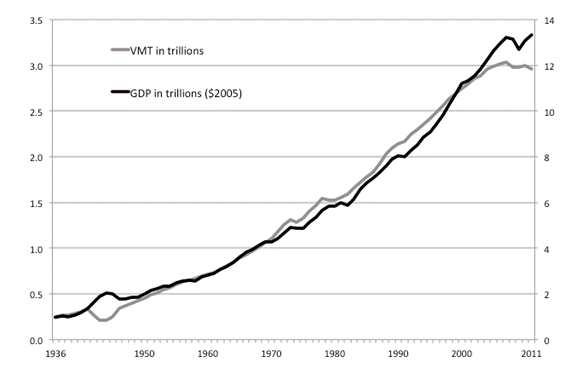
For years, planners and economists assumed a pretty tight relationship between vehicle miles traveled and GDP growth, and they were largely justified. In the last five years, however, the situation has started to change.
Third, from a fiscal (and to a certain extent an environmental) perspective, more traffic, if it can be controlled by traffic management systems, means more efficient use of the roads. This is generally true at the metro area level that Cox is analyzing since most roads are far below capacity most of the time (it’s not necessarily true for a particular road after it reaches the congestion point). Areas that have very low traffic congestion are probably paying far too much for their roads given their (probably poor) economic power.
I will use this as yet another excuse to post my comparison of the amount of pavement per vehicle in Charlottesville vs the pavement per vehicle in suburban Albemarle County:


Cox argues that denser metro areas also have more traffic. He argues that part of the reason is their unwillingness to build new highways and that less traffic can be an economic advantage for an area.
By Cox's reasoning, low-density Richmond should have a huge economic advantage since it has the least congestion of any major metro area. Hampton Roads (which is actually even less dense than Richmond) doesn't fare quite as well but is still on the low end for traffic.
There are a couple of small problems even with this graph. Bacon points out one - Cox fails to take into account that larger metro areas simply have more traffic regardless of their density - and that they also tend to get denser as more people try to stay connected to the core of the area. Another is that he looks only at the delay during peak periods, which tells us how bad rush hour can be but isn't always a good metric for traffic in general.
But these are both minor points. The real problem with Cox's analysis is that he makes a point that is correct and obvious, then draws or infers conclusions that are completely incorrect. More density does, of course, mean more congestion. If there are more people in a given area, there will be more of them going places and doing things. And just building new transit or making areas walkable does not mean that there will be less visible traffic on the roads. Because roads are free and convenient, people tend to max them out before shifting to other modes. But more visible traffic is not a sign that density is dysfunctional, nor is it always a bad thing for cities, for several reasons.
First, he measures traffic congestion rather than access. The two are very, very different. Most people perceive the inconvenience of traffic in terms of how fast they can drive on a road, which is ridiculous. They ought to evaluate it in terms of their increased or decreased access to possible destinations. So yes, ten minutes of driving in Manhattan might barely get you a mile. But that mile driving radius gets you access to a million people, several million jobs, and tens of thousands of retail stores and restaurants. Contrast that with suburban Richmond. Ten minutes of driving in Chesterfield County might get you geographically farther in any one direction (including time on side streets to get to destinations), but that only gives you access to less than a hundred thousand people, and not nearly the concentration of jobs or amenities. Cities create value by being markets and markets that can provide access to more people result in more value creation. Part of that access also involves being able to use different modes based on the different circumstances of the trip. This mapping application, which is fantastic, gives a better idea of how much access cities are creating for their people and how traffic affects that: http://www.flaviogortana.com/isoscope/.
Here's a ten minute drive in Manhattan, covering an area inhabited by nearly a million people, with millions more jobs:
vs. Chesterfield County, where a ten minute drive gets you access to less than a hundred thousand people and jobs:
The same argument crops up between fire departments and planning departments. Fire departments, worried about their response times, often push for large roads and unsafe pedestrian infrastructure that pushes people further out. Even though they can't travel as quickly in denser cities, the concentration of people means more fire stations. In central Boston, response times are a fourth of what they are in the outer suburbs. Even here in Charlottesville, city stations can respond in less than half the time that county stations can, their complaints about narrow streets and tight corners notwithstanding.
Second, Cox fails to mention that, while traffic may correlate somewhat with density, it correlates even better with economic growth or decline. And that sort of invalidates his argument about a lack of traffic being a major draw. It is a draw – in the same sense that an empty room at a party is attractive if one room is overcrowded. But the whole reason you are at the party is to talk to people, so there is a reason the most crowded room tends to get more crowded over time until a group can form that’s large enough to spin off another conversation. The areas with the most traffic also tend to be the areas with the highest median incomes. Traffic is a sign that people have things to do and places to go. When the economy tanks and unemployment rises, traffic tends to get lighter.
For years, planners and economists assumed a pretty tight relationship between vehicle miles traveled and GDP growth, and they were largely justified. In the last five years, however, the situation has started to change.
Third, from a fiscal (and to a certain extent an environmental) perspective, more traffic, if it can be controlled by traffic management systems, means more efficient use of the roads. This is generally true at the metro area level that Cox is analyzing since most roads are far below capacity most of the time (it’s not necessarily true for a particular road after it reaches the congestion point). Areas that have very low traffic congestion are probably paying far too much for their roads given their (probably poor) economic power.
I will use this as yet another excuse to post my comparison of the amount of pavement per vehicle in Charlottesville vs the pavement per vehicle in suburban Albemarle County:
Thursday, June 5, 2014
How to Eliminate Gerrymandering
Massachussetts software engineer Brian Olson wrote an algorithm to allocate census blocks into optimally compact equal-population districts.
Chris Ingram writes on the Washington Post's political blog:
Yesterday, I asked readers how they felt about setting up independent commissions to handle redistricting in each state. Commenter Mitch Beales wrote: "It seems to me that an 'independent panel' is about as likely as politicians redistricting themselves out of office. This is the twenty-first century. How hard can it be to create an algorithm to draw legislative districts after each census?" Reader "BobMunck" agreed: "Why do people need to be involved in mapping the districts?"
Here's Virginia in 2010 according to Olson's algorithm. Congress:

House of Delegates:

State Senate:

Jim Bacon had a post recently on Virginia's seeming stagnation when it comes to implementing new ideas in government. How about being the first state to do this?
I am also a big fan of California's Proposition 14, which consolidates all primaries into a single election. The two candidates receiving the highest number of votes then advance to the general election - essentially a runoff system similar to that used in many other countries. It removes the incentives in the primary stage to cater to the most extreme parts of the base and allows less conventional combinations of political views that might have cross-party appeal to make a case to the whole public.
Either of these innovations might help us do something about the incredibly non-competitive (and therefore not particularly democratic) Virginia state legislature.
Chris Ingram writes on the Washington Post's political blog:
Yesterday, I asked readers how they felt about setting up independent commissions to handle redistricting in each state. Commenter Mitch Beales wrote: "It seems to me that an 'independent panel' is about as likely as politicians redistricting themselves out of office. This is the twenty-first century. How hard can it be to create an algorithm to draw legislative districts after each census?" Reader "BobMunck" agreed: "Why do people need to be involved in mapping the districts?"
Here's Virginia in 2010 according to Olson's algorithm. Congress:

House of Delegates:

State Senate:

Jim Bacon had a post recently on Virginia's seeming stagnation when it comes to implementing new ideas in government. How about being the first state to do this?
I am also a big fan of California's Proposition 14, which consolidates all primaries into a single election. The two candidates receiving the highest number of votes then advance to the general election - essentially a runoff system similar to that used in many other countries. It removes the incentives in the primary stage to cater to the most extreme parts of the base and allows less conventional combinations of political views that might have cross-party appeal to make a case to the whole public.
Either of these innovations might help us do something about the incredibly non-competitive (and therefore not particularly democratic) Virginia state legislature.
Thursday, May 1, 2014
Walmarts Over Downtowns II: Southwest VA
A lot of people have been interested in the Walmart visuals from a while back. I had one request to do a few more for towns in southwest Virginia - and indeed I did neglect to include any from that area. Here are five more.
Bristol (Walmart, Sam's Club, and Lowe's):

Christiansburg:

Galax:

Lebanon:

Wytheville:

Bristol (Walmart, Sam's Club, and Lowe's):
Christiansburg:
Galax:
Lebanon:
Wytheville:
Tuesday, April 15, 2014
The Importance of Car-sharing

Addendum: check out this post on Atlantic Cities by Paul Supawanich, which deals with another side of the equation.
Lyft's expansion into Hampton Roads is creating consternation at the State House. In the past few years, there have been numerous car-sharing innovations, from Zipcar, Lyft, and Uber to websites that allow users to more easily share rides in the same direction. These services are crucial to the future of urbanism in the US.
But some urbanists have been lukewarm. Fundamentally, they say, shared cars are still cars. These critics are missing the bigger picture. Car-sharing services allow vastly more people to give up car ownership. One recent study suggested that Zipcar and other car-sharing services replace 32 private cars with one shared car and have resulted in as many as 500,000 fewer new car sales since their appearance. Each of those private cars was taking up space in the city and resulting in more traffic.
Shared cars take all expenses of car ownership and boil them down to a trip cost. This is a critical change. Car ownership forces high fixed expenditures that become sunk costs for the owners. They've already shelled out for the car, so they might as well drive it. The car reorients its owner's brain towards living and shopping in places that were conveniently laid out for cars, rather than for people.
Think of it this way. Here's all the trips that a hypothetical family living in a relatively walkable urban area might make in 3 months. We'll say... central Winchester. The height of the bar represents the marginal value of having a car for each trip and the trips are organized from most to least valuable.

Once the accumulated value of the trips on the left is enough to justify owning a car, suddenly housing and shopping decisions are made based on the car. Since you're already driving to work every day, you might as well live in a place where you can only get to work via car. And your company might as well build an office that you can only get to via car. And your city might as well design its infrastructure around the fact that none of those employees are driving. And transit options disappear without customers. And now, suddenly, the marginal value of owning the car is extremely high for every commute, every errand, and even every optional trip. Indeed, you risk being unemployed and living in social isolation without it.
The secret of the shared car's ability to reduce vehicle trips lies in the marginal (meaning additional) value of the trips that people are currently taking. Every time you think about going somewhere, you have decisions to make. Do you drive to work or bike today (this is called "mode choice")? Do you run up to the grocery to get an extra box of pancake mix or do you wait until 3 when you'll be at the dentist already (this is called "trip-chaining")?
Some of those trips are extremely valuable - eg running your wife to the hospital when she goes into labor or (to use a less extreme example) being able to visit your cousins in a rural area - so much so that they force you to own a car. While there are lots of costs associated with driving, the biggest ones are fixed (or "capital") costs - the price of the car and its depreciation, the maintenance and upkeep of the vehicle, insurance and taxes, etc.
The costs people weigh when deciding what mode to use are variable costs - often just gasoline. Even these costs are usually underestimated. Maintenance from additional mileage doesn't factor in for most people. And buying gas is such a habit that few people actually sit down before each trip and calculate the cost of the trip.
All that to say, the real financial benefits of not driving only come when one can avoid even owning a car. And the really economically correct choices are made only when all auto-related costs are boiled down into a trip-by-trip cost that the driver can weigh against the value of the trip. Car sharing schemes allow people who are already close to being able to live without a car to finally give up car ownership.
Thursday, April 3, 2014
"Elected" Representatives

Thursday, March 27, 2014
Revised Development Projections

I've been working on a revised version of the development projection images that I did a while back. I wrote a long post about it on Stat Chat that has the full images and some commentary on them. Here I wanted to explain a little more of the technical background on how I made them.
How Is This Constructed?
The model starts with a random value in a Poisson distribution that simulates the likelihood of development. This distribution captures the fact that some parcels will develop seemingly at random. As different circumstances change, more and more areas will develop until finally the vast majority of land in an urban area will develop. After that, some undeveloped plots will remain for a while and a few will simply never develop.
The values in this raster are then raised by adding a score based on the driving time to major employment centers. This is because most development is and has been automobile-driven. The shape of an urban area is highly predictable based on the driving time to an employment center. Lastly, I reduced the likelihood of development based on the slope of the terrain and subtracted all national and state parks, wetlands, military bases, conservation easements, and local parks that were in some way preserved. I then split this model up into planning district commissions because they roughly encompass metro areas that expand outward from a core.
The density that I used was the same density of development in the district that I was adjusting. So if the developed areas of a planning district had a density of 1000 persons per acre, that's the density I used for the predicted new residents also. These densities are likely to be off because of several factors. They could be too high because, while areas have been gaining population over the last 50 years, the existing population has also been decentralizing and new residents are likely to buy the lowest density homes on the periphery. On the other hand, they could be too low because, as areas grow in size, they become denser and each new person's marginal amount of developed area is a little smaller. Additionally, the trend in recent years has swung the other way, as I pointed out earlier in the post. For lack of a better model, I considered it a wash and stuck with the existing density.
Cities and driving distances:

Slope:

Conserved land:

Growth likelihood raster and planning district boundaries. Some counties are shared by planning districts - I had to assign these to one district and deduct their population numbers from the other.

I'd be very interested to hear of ways you think this could be improved or additional factors that could be added in. One I thought of was buffering around the Chesapeake Bay and other bodies of water to account for the attraction of living by the water. Another is doing a more comprehensive service area just around the roads to get more of the development aligned with roads rather than "speckled" about. The problem with that is that new developments come with new roads and you don't know where they're going to be.
Wednesday, March 19, 2014
MSA's and Commuting
New post on Statchat looking at the dependence of rural counties on nearby urban areas.
Percent of workers commuting to the Washington, DC area:

Percent of workers commuting to the Washington, DC area:
Sunday, March 16, 2014


Wednesday, March 12, 2014
In Which I Acquire a New Toy
Namely - Tom Gross's cartogram script for ArcGIS.
Virginia counties distorted to make area correspond to population:

Where you from?
Why do Hampton Roads and Northern VA seem so different from the rest of Virginia? At the macro level, it's pretty obvious - the influence of the Federal government in DC and the military in Hampton Roads. But it's even more obvious on this map, which shows the percentage of the population born in Virginia. Blue means born here, red means born elsewhere:

Percentages are high in Hampton Roads - especially around military bases. But almost the entire northern Virginia metro area is in the red. Fewer than 30% of NoVA residents in most areas were born in Virginia.
Here's another map showing the percentage of the population born outside the U.S. See the Weldon Cooper Center's post on immigration for more on this subject.

A few quick regressions on excel shows a pretty strong link between places that have more bachelor's degrees, more people born outside VA, and a higher income. It's not a particularly new revelation - the more education and earning power a person acquires, the more geographically mobile they become.
Percentages are high in Hampton Roads - especially around military bases. But almost the entire northern Virginia metro area is in the red. Fewer than 30% of NoVA residents in most areas were born in Virginia.
Here's another map showing the percentage of the population born outside the U.S. See the Weldon Cooper Center's post on immigration for more on this subject.
A few quick regressions on excel shows a pretty strong link between places that have more bachelor's degrees, more people born outside VA, and a higher income. It's not a particularly new revelation - the more education and earning power a person acquires, the more geographically mobile they become.
Tuesday, March 11, 2014
Tract Facts
Nothing too special here in the way of analysis - was just curious about a few subjects so I thought I'd throw them onto a census tract map. The roads are interstates to help you get your bearings.
Percent of population 25 years and older who have a Bachelor's degree or higher:

Adults that are currently married:

Percent of population who moved in the last year:

Percent of population 25 years and older who have a Bachelor's degree or higher:
Adults that are currently married:
Percent of population who moved in the last year:
Monday, March 10, 2014
Sprawl: A Compact History
I am currently reading Robert Bruegmann's well-researched screed against the planning establishment's complaints about sprawl. It's an excellent read and a tremendous hairshirt for all students steeped in planning school dogma. In the end, though, his arguments succumb to many of the same historical reductions and internal contradictions that he is decrying in others. Just a few great quotes that stuck out to me:

"It is possible that even when a small, remote star explodes, this event can reorder the entire gravitational system of a galaxy. A slight wobble in the axis of a planet can mean drastic warming in one area and cooling in another. So it is with urban systems, the main difference being that the most basic element in the urban system is the individual human being who can think and make decisions. Any change made by any member of any neighborhood affects, to some degree, everyone else in the metropolitan area."
p. 94
"The term 'sprawl' has never had a coherent or precise definition. This has been one of the reasons it has been such a powerful polemical tool. Thinking of it as a blank screen on which a great many people project their own feelings of discontent with contemporary urban conditions is a good way to approach the history of the anti-sprawl movement. Because of the lack of a precise agreement about what sprawl is, individuals have been free to rally around certain broad but quite abstract concepts as a way to explain what is wrong with developments they see around them without necessarily agreeing on any specific diagnosis of the problems or any concrete set of prescriptions. It has allowed people with radically different assumptions to find common cause."
p. 115
"The same homebuyers who might try to maximize their personal advantage in buying a suburban house are the voters who elect government officials and who push for land-use regulations that will benefit them, often at the price of other parts of the population. Is it logical to think that landowners would suddenly act in a completely different fashion when they engage in political rather than economic transactions? Nor is the kind of behavior that puts personal interest above community welfare peculiar to low-density settlements. The resident of a central city who tries to block the badly needed expansion of a hospital next door to his apartment building because it would block his view is acting in a similar fashion."
p. 99
"Affluent residents of Youngstown who move to the exurban fringe are merely exploiting one of the most important assets available in the metropolitan area - a large supply of attractive land at low prices. Although at first glance it appears that the dispersal to the edges does little other than eviscerate the central cities and displace agriculture, in many cases, the possibility of building a house on a large tract of inexpensive land in the exurban fringe is the one thing that continues to attract middle-class residents who might otherwise flee to more dynamic regions. If, as is quite likely, Youngstown's downtown and central residential districts revive, it will not be despite sprawl but because sprawl has made it possible for the metropolitan area to retain residents during extremely difficult years."
p. 89
"In the early years of the 21st century, it appears that the forces of renewal and gentrification are becoming dominant in an increasing number of central cities. The old 'crisis of the central city,' in which jobs were departing and property values plunging, could well turn out to have been a short-lived phenomenon...
Many smart growth activists believe that as people return to the city in greater numbers, this movement of people will create population gains and an increased density that will reduce the pressure for outward expansion. Increasingly, however, as affluent citizens have moved to the center, they are doing just what their counterparts have long done in the suburbs. They have found that they can use zoning ordinances, historic preservation measures, environmental regulations, and other means to resist continued change, to control the appearance and character of their neighborhoods, and to stop densities from rising. In city after city, the old zoning codes have been downzoned time and again to reduce the ultimate possible population and prevent existing densities from rising."
p.57-58
"What few people seemed to notice was the way the rising fortunes of the center, like their earlier decline, were directly connected to developments at the edge. As more and more businesses and people, including even some of the least affluent members of the urban community, arrived at the urban periphery, it lost much of its exclusivity and social cachet. The number of individuals at the very top of the social ladder who wished to buy large houses in the farthest subdivision declined dramatically in the last decades of the twentieth century. As this happened, the central city and older established suburbs began to regain some of the luster they had lost in the postwar decades.
One of the ironies of this revival is that while central cities have traded on their 'traditional' character, much of what is most attractive about them is the fact that so many of the things that once defined them have disappeared. The decanting outwards of all kinds of manufacturing and warehousing functions led to dramatic reduction in street congestion, truck traffic, and pollution. This allowed city centers to become increasingly attractive to those who have the choice to live anywhere they wish in the metropolitan area and who in previous decades might well have chosen to live in the suburbs or exurbs."
p. 53-54
- Robert Bruegmann

"It is possible that even when a small, remote star explodes, this event can reorder the entire gravitational system of a galaxy. A slight wobble in the axis of a planet can mean drastic warming in one area and cooling in another. So it is with urban systems, the main difference being that the most basic element in the urban system is the individual human being who can think and make decisions. Any change made by any member of any neighborhood affects, to some degree, everyone else in the metropolitan area."
p. 94
"The term 'sprawl' has never had a coherent or precise definition. This has been one of the reasons it has been such a powerful polemical tool. Thinking of it as a blank screen on which a great many people project their own feelings of discontent with contemporary urban conditions is a good way to approach the history of the anti-sprawl movement. Because of the lack of a precise agreement about what sprawl is, individuals have been free to rally around certain broad but quite abstract concepts as a way to explain what is wrong with developments they see around them without necessarily agreeing on any specific diagnosis of the problems or any concrete set of prescriptions. It has allowed people with radically different assumptions to find common cause."
p. 115
"The same homebuyers who might try to maximize their personal advantage in buying a suburban house are the voters who elect government officials and who push for land-use regulations that will benefit them, often at the price of other parts of the population. Is it logical to think that landowners would suddenly act in a completely different fashion when they engage in political rather than economic transactions? Nor is the kind of behavior that puts personal interest above community welfare peculiar to low-density settlements. The resident of a central city who tries to block the badly needed expansion of a hospital next door to his apartment building because it would block his view is acting in a similar fashion."
p. 99
"Affluent residents of Youngstown who move to the exurban fringe are merely exploiting one of the most important assets available in the metropolitan area - a large supply of attractive land at low prices. Although at first glance it appears that the dispersal to the edges does little other than eviscerate the central cities and displace agriculture, in many cases, the possibility of building a house on a large tract of inexpensive land in the exurban fringe is the one thing that continues to attract middle-class residents who might otherwise flee to more dynamic regions. If, as is quite likely, Youngstown's downtown and central residential districts revive, it will not be despite sprawl but because sprawl has made it possible for the metropolitan area to retain residents during extremely difficult years."
p. 89
"In the early years of the 21st century, it appears that the forces of renewal and gentrification are becoming dominant in an increasing number of central cities. The old 'crisis of the central city,' in which jobs were departing and property values plunging, could well turn out to have been a short-lived phenomenon...
Many smart growth activists believe that as people return to the city in greater numbers, this movement of people will create population gains and an increased density that will reduce the pressure for outward expansion. Increasingly, however, as affluent citizens have moved to the center, they are doing just what their counterparts have long done in the suburbs. They have found that they can use zoning ordinances, historic preservation measures, environmental regulations, and other means to resist continued change, to control the appearance and character of their neighborhoods, and to stop densities from rising. In city after city, the old zoning codes have been downzoned time and again to reduce the ultimate possible population and prevent existing densities from rising."
p.57-58
"What few people seemed to notice was the way the rising fortunes of the center, like their earlier decline, were directly connected to developments at the edge. As more and more businesses and people, including even some of the least affluent members of the urban community, arrived at the urban periphery, it lost much of its exclusivity and social cachet. The number of individuals at the very top of the social ladder who wished to buy large houses in the farthest subdivision declined dramatically in the last decades of the twentieth century. As this happened, the central city and older established suburbs began to regain some of the luster they had lost in the postwar decades.
One of the ironies of this revival is that while central cities have traded on their 'traditional' character, much of what is most attractive about them is the fact that so many of the things that once defined them have disappeared. The decanting outwards of all kinds of manufacturing and warehousing functions led to dramatic reduction in street congestion, truck traffic, and pollution. This allowed city centers to become increasingly attractive to those who have the choice to live anywhere they wish in the metropolitan area and who in previous decades might well have chosen to live in the suburbs or exurbs."
p. 53-54
- Robert Bruegmann
Thursday, March 6, 2014
More Pavement
I continue my quest to be the Ken Pomeroy of impervious surfaces. Here's a nicer visual with new data from Lynchburg and James City County, giving us a much smoother and more indicative index - from dense city to mixed city to suburban county to suburban/exurban county.

Monday, March 3, 2014
Four reasons bikes should not pay the same fines as cars
Thanks to Brian Davis at Cville Tomorrow for publishing this. The link is here. I've edited the manuscript a bit as a result.
Bike tickets are on the rise and they carry the same fines and legal consequences that vehicle infractions do.
This system is a bad one for four big reasons:
1. The cost of a ticket is disproportionate to the cost of riding a bicycle
The cost of a traffic ticket is scaled to the cost of owning and driving an automobile. One ticket costs about as much as it costs the average American to own and drive a car for a week. That’s enough to be a reasonable deterrent, but not an unreasonable expense for someone paying an average of almost $8,000 a year to own a car and drive it.
For most riders, bikes are a cheaper alternative. They are a way for people with less disposable income to get access to some of the same opportunities as those who can afford to drop money on cars, gas, and parking. They allow people to trade comfort and some speed for savings and exercise. Getting a bicycle ticket threatens this trade-off immensely.
While $150 is a drop in the bucket for a car owner, it may be half the cost of a bicycle and more than it costs to ride a bike for a year. That’s a huge risk. A ticket a year only slightly raises the cost of driving. A bike ticket a year makes biking almost not worth it, putting another car back on the road or depriving someone of reliable transportation. Compare it to the outrage drivers felt in 2007 when the state legislature tried to increase fines by 700% to make up our traditional transportation budget shortfall. The costs were simply unreasonable for drivers to absorb in comparison to the other costs of driving. Current ticket prices for bikers are just as unreasonable.
2. Bicycles are not 2-ton blocks of metal that go 70 mph and kill thousands of people a year
Fines are high for traffic violations because traffic violations are a big deal. Cars kill over 30,000 people a year in the United States and injure hundreds of thousands of others. Cars are weapons that can do serious and expensive damage to others on the road – including cyclists, whom they kill at a rate of over 600 a year.
Bicycles, to put it simply, do not. The dangers posed by the two modes are several orders of magnitude apart. As much as drivers may rail about the behavior of bicyclists being unsafe or causing accidents, there are almost no recorded incidents of a vehicle occupant being injured because of the actions of a bicyclist. You have a better chance of becoming President of the United States than of getting hurt by a bicyclist while you are in a car. The only people reckless bikers put in danger on the road are themselves.
Bikes can be a danger to pedestrians, especially if ridden on the sidewalk. Yet they still injure pedestrians much less frequently (and less severely) than cars do. By comparison, around four thousand pedestrians are killed by cars every year and tens of thousands are injured.
3. It is often difficult for bicyclists to follow the rules safely
We are not yet at the point where cycling according to the rules is an easy feat. Many traffic signals only change when a car pulls up to them. Rocks, glass, snow, and other debris in bike lanes often force bicycles to swerve in and out. When they do so, they risk being charged with “reckless driving,” a widely abused citation for cyclists. Coming to a complete stop rather than a rolling stop at stop signs forces cyclists to put a foot down and waste additional time starting again, angering motorists behind. Cyclists can get tickets for failing to signal turns, which is often unsafe. While signaling, the cyclist risks losing control of the bicycle as well as the ability to brake with that hand. These and other problems are not insurmountable, but the roadway is still a harsh place for bikes. The rules are not as tailor-made or easy to follow as they are for vehicles.
4. Motorists are almost never held responsible for collisions with bicycles
Negligent drivers who injure passengers in another car can expect to pay hefty insurance bills and potentially face legal consequences. But if they hit or even kill a cyclist, there are rarely any consequences at all. Read Daniel Duane's excellent op-ed in the NYT: "Is it ok to kill cyclists?" It's a nationwide issue, but Virginia is a particular offender. We are consistently unable to get even common sense protections for bicyclists on the road, including a shameful vote in committee last month to kill a bill protecting bikes from "dooring."
The Economist has this to say about American traffic laws: "[M]otorists in America generally receive no punishment whatsoever for crashing into or killing cyclists, even when the accident is transparently their fault. This insane lacuna in the justice system reflects extreme systemic prejudice by drivers against cyclists, and would be easy enough to fix."
The only place where cyclists are treated as equals is when being fined for traffic violations.
The solution: better infrastructure, better laws, rescaled fines
Bike lanes and separated cycle tracks are the only way to make cycling truly safe and effective as a means of transportation. In the meantime, we need two things:
1. Amended rules for cyclists that allow them to use their natural advantages to everyone’s benefit and grant them the same common sense protection given to every other type of vehicle.
2. A scaled-down fee schedule. Moving violations should cost about one tenth the equivalent vehicle fine to reflect the difference in cost of ownership. Most bike tickets should range from $10 to $20. Before this can work, Virginia needs to fix its absurd system of flat “court costs.”
If we scaled down these costs and fixed our bicycle laws, then I might be in favor of handing out more tickets.

Bike tickets are on the rise and they carry the same fines and legal consequences that vehicle infractions do.
This system is a bad one for four big reasons:
1. The cost of a ticket is disproportionate to the cost of riding a bicycle
The cost of a traffic ticket is scaled to the cost of owning and driving an automobile. One ticket costs about as much as it costs the average American to own and drive a car for a week. That’s enough to be a reasonable deterrent, but not an unreasonable expense for someone paying an average of almost $8,000 a year to own a car and drive it.
For most riders, bikes are a cheaper alternative. They are a way for people with less disposable income to get access to some of the same opportunities as those who can afford to drop money on cars, gas, and parking. They allow people to trade comfort and some speed for savings and exercise. Getting a bicycle ticket threatens this trade-off immensely.
While $150 is a drop in the bucket for a car owner, it may be half the cost of a bicycle and more than it costs to ride a bike for a year. That’s a huge risk. A ticket a year only slightly raises the cost of driving. A bike ticket a year makes biking almost not worth it, putting another car back on the road or depriving someone of reliable transportation. Compare it to the outrage drivers felt in 2007 when the state legislature tried to increase fines by 700% to make up our traditional transportation budget shortfall. The costs were simply unreasonable for drivers to absorb in comparison to the other costs of driving. Current ticket prices for bikers are just as unreasonable.
2. Bicycles are not 2-ton blocks of metal that go 70 mph and kill thousands of people a year
Fines are high for traffic violations because traffic violations are a big deal. Cars kill over 30,000 people a year in the United States and injure hundreds of thousands of others. Cars are weapons that can do serious and expensive damage to others on the road – including cyclists, whom they kill at a rate of over 600 a year.
Bicycles, to put it simply, do not. The dangers posed by the two modes are several orders of magnitude apart. As much as drivers may rail about the behavior of bicyclists being unsafe or causing accidents, there are almost no recorded incidents of a vehicle occupant being injured because of the actions of a bicyclist. You have a better chance of becoming President of the United States than of getting hurt by a bicyclist while you are in a car. The only people reckless bikers put in danger on the road are themselves.
Bikes can be a danger to pedestrians, especially if ridden on the sidewalk. Yet they still injure pedestrians much less frequently (and less severely) than cars do. By comparison, around four thousand pedestrians are killed by cars every year and tens of thousands are injured.
3. It is often difficult for bicyclists to follow the rules safely
We are not yet at the point where cycling according to the rules is an easy feat. Many traffic signals only change when a car pulls up to them. Rocks, glass, snow, and other debris in bike lanes often force bicycles to swerve in and out. When they do so, they risk being charged with “reckless driving,” a widely abused citation for cyclists. Coming to a complete stop rather than a rolling stop at stop signs forces cyclists to put a foot down and waste additional time starting again, angering motorists behind. Cyclists can get tickets for failing to signal turns, which is often unsafe. While signaling, the cyclist risks losing control of the bicycle as well as the ability to brake with that hand. These and other problems are not insurmountable, but the roadway is still a harsh place for bikes. The rules are not as tailor-made or easy to follow as they are for vehicles.
4. Motorists are almost never held responsible for collisions with bicycles
Negligent drivers who injure passengers in another car can expect to pay hefty insurance bills and potentially face legal consequences. But if they hit or even kill a cyclist, there are rarely any consequences at all. Read Daniel Duane's excellent op-ed in the NYT: "Is it ok to kill cyclists?" It's a nationwide issue, but Virginia is a particular offender. We are consistently unable to get even common sense protections for bicyclists on the road, including a shameful vote in committee last month to kill a bill protecting bikes from "dooring."
The Economist has this to say about American traffic laws: "[M]otorists in America generally receive no punishment whatsoever for crashing into or killing cyclists, even when the accident is transparently their fault. This insane lacuna in the justice system reflects extreme systemic prejudice by drivers against cyclists, and would be easy enough to fix."
The only place where cyclists are treated as equals is when being fined for traffic violations.
The solution: better infrastructure, better laws, rescaled fines
Bike lanes and separated cycle tracks are the only way to make cycling truly safe and effective as a means of transportation. In the meantime, we need two things:
1. Amended rules for cyclists that allow them to use their natural advantages to everyone’s benefit and grant them the same common sense protection given to every other type of vehicle.
2. A scaled-down fee schedule. Moving violations should cost about one tenth the equivalent vehicle fine to reflect the difference in cost of ownership. Most bike tickets should range from $10 to $20. Before this can work, Virginia needs to fix its absurd system of flat “court costs.”
If we scaled down these costs and fixed our bicycle laws, then I might be in favor of handing out more tickets.

Subscribe to:
Posts (Atom)